
The Headline: August ran on everyone else's calendar but mine.
Most of the month went into looking for a wedding venue, which I expected to be about the touring and has mostly been about the record keeping. Every place quotes you a little differently and none of it lines up side by side, so a lot of August was me trying to get all of it somewhere I could actually read it.
We got away to Cape Cod and saw family and had a relaxing time in a small BnB. A much needed getaway for the both of us.
Posts
July 2026 Review — Review of July 2026, maximizing outside time and soaking up the pockets of summer we’ve had.
The Numbers Are for Decisions, Not Scoreboards — I think about team performance a lot. A LOT. With the way AI has changed some of the velocity metrics, I thought I’d write a bit about how I think about the true metrics of a team.
Building Hogline for watchOS — A couple thoughts on building my first watchOS app and what stood out to me as snags in my learning.
Books That Stuck
I read a bunch of sci-fi this month, since I’ve been travelling and doing a bunch of planning it was easier to throw on some stories in audio form than to sit down with something super thought provoking. That is other than the Reverse Centaur book (not scifi)
The Reverse Centaur's Guide to Life After AI by Cory Doctorow, the person who coined Enshittification. This book goes into the difference of being a user of AI and being used by AI. Worth the read.
Some Links
The New Realities of EM Lyfe — Cate Huston on how the ground under engineering management has shifted with AI and the end of the seller’s market. The uncomfortable parts: attrition is now treated as a feature, not a bug ("why develop your people if attrition will sort it out"), and mass layoffs have become the new blunt instrument — bureaucratically easier than a PIP, which at least required you to have been managing someone. Her reframe of the EM as a force multiplier is the constructive core: in a growth market a 1x manager had value, now the bar is higher, and you have to figure out where to spend your care because the org won’t tell you.
The end of the non-technical engineering manager — James Stanier’s argument that the coordination layer — status updates, progress tracking, routing information between people — is being compressed from both directions: org flattening from above, AI from below. People management is necessary but no longer sufficient. What’s rising in value is the compound skill: a manager who can coach and develop people and answer how the system scales without pulling someone else into the room. Pairs almost too neatly with the Huston piece, same shift, one from the emotional/market side, one from the technical-bar side.
Celebrating 21 Years at Microsoft — Adam Harmetz, a VP of product and data science there, writing 21 lessons as a letter to his younger self. The one that stuck is that every paradigm shift in your industry resets everything and forces you to show up differently, which is now the third version of that argument in this month’s links. His framing of the PM job is the part I’ll actually use: you’re not there to own the customer insight and explain it, you’re there to teach engineering and design until they know the customer as well as you do. Same shape as Huston’s force multiplier idea, just told by someone who stayed in one place long enough to watch the reset happen three times.
Kurt Vonnegut's 8 Tenets of Storytelling — Maria Popova collecting Vonnegut’s eight rules for writing short stories. Most of them are fiction rules that don’t transfer, but the first one is a decent test for anything I put on this blog: use the time of a total stranger in such a way that he or she will not feel the time was wasted. The other keeper is that every sentence has to do one of two things, reveal character or advance the action, which is a harsher edit than I usually give myself. The one I keep arguing with is write to please just one person, and I suspect that means it’s the one I need.
Being 'Good' at Things — Jim Nielsen on what being good at something actually means, arrived at through golf. Collin Morikawa’s answer is that there’s no number, you just have to finish out every hole without picking up a two-footer. Nielsen’s own version: relieving yourself of the exacting burden of the reality of the game is the easy way to play, but it doesn’t make you better. Picking up the two-footer is the golf version of the corner I wrote about cutting in the numbers post this month, the throughput number that looks fine because nobody sees what got skipped. Same conclusion, reached from a golf course instead of a sprint board.
Life Lately
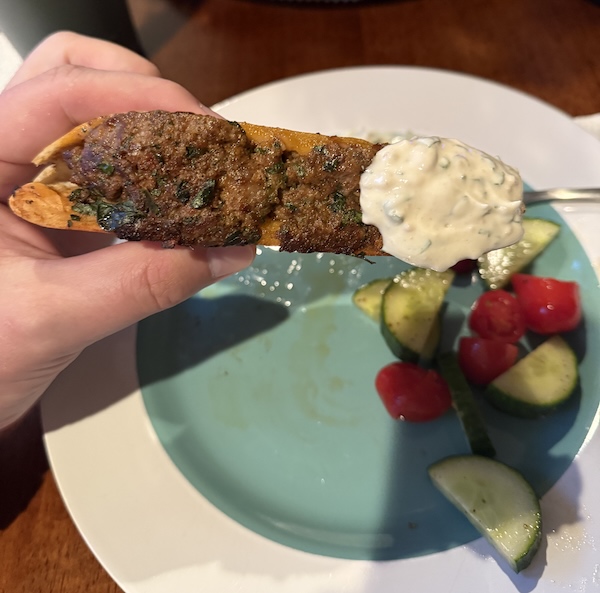
Made some Arayes for dinner for the first time, with a nice yogurt dipping sauce and a tasty tomato and cucumber salad. Wow it was good. Give this one a try.

Took a shot of the pup mid yawn on our morning walk as the sun is rising. Such gold.

Cape Cod as the sun sets. It was beautiful, great temperature and the beach was lovely.

Got to see Like Roses live this month, one of my favorite bands right now.
One Thing to Carry Forward
Touring the venues was the easy part. The work was getting every quote into one place where I could read them side by side, and that took more of August than the touring did. In September I want to set that part up first, before there’s a pile to sort.