
When I first started using AI in my workflow, I did what most people do. I automated the annoying stuff. I built a skill to gather data points from my team and drop them into a Google Sheet for velocity tracking. Took me a few minutes a week before. Now it takes zero.
Cool, I guess. But not exactly life-changing.
The real shift happened when I stopped thinking about what I could automate and started thinking about what I actually needed. That's a different question. And it led me somewhere way more interesting.
From Automation to Partnership
Leadership work can be messy. You’re pulling signal from a dozen different places, like Slack threads, Google docs, email, calendar, dashboards, while trying to make sense of it fast enough to actually be useful in the room. The bottleneck isn’t your judgment. It’s the time it takes to gather and synthesize all that context before you can even apply your judgment.
So I started building something different.
I started building skills that don’t just run tasks but work with me. Take my scattered notes from the week and help me figure out what actually matters. Pull data from multiple sources and give me a single coherent picture before my meetings start in the morning. Challenge a doc I’ve written before I share it with the team. Help me prep for a tough conversation by stress-testing my thinking.
These aren’t automations. They’re more like having a sharp analyst who’s read everything you’ve read and is ready to go whenever you are. If you’re juggling a lot of work streams, this stuff compounds fast.
The Data Gathering Problem
The thing that surprised me most was how much of my time was going to gathering information, not using it. Checking five different places to get a status update. Re-reading the same Slack thread twice because I lost the context. Trying to remember what we decided in last week's meeting.
Building a personal assistant that knows where my data lives, what’s most interesting to me for that day and can pull it together on demand has been genuinely transformative. Instead of starting a the day by hunting around for context across dozens of channels and docs, I start the day with a brief. It's not perfect. But it's dramatically better than the alternative.
What the Brief Actually Does
Here's how it actually works in practice.
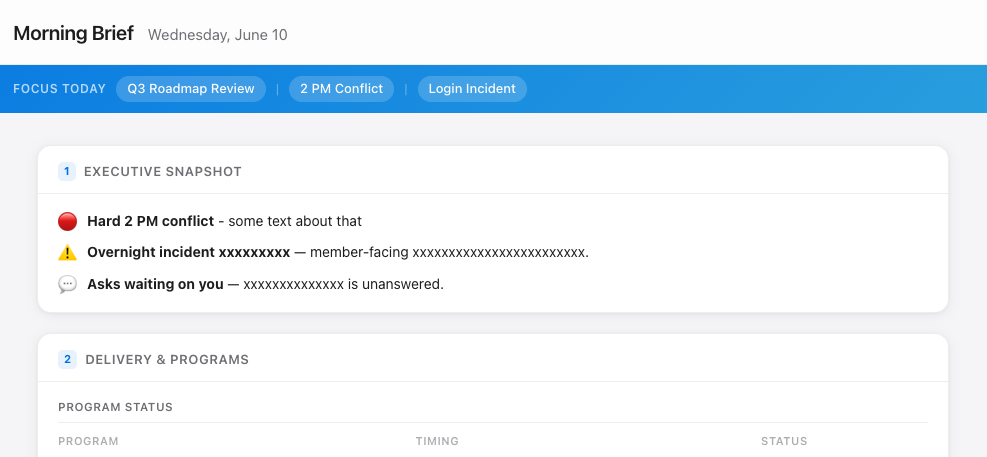
The brief runs through several streams in parallel. First, my calendar. Every meeting gets labeled — 1:1, team meeting, interview, or other — and flagged if there's a conflict, a back-to-back, or something that needs real prep. Then it dives into the meeting notes, Slack threads, Jira tickets, and GitHub to build out three prep bullets per person for every 1:1 I have that day.
From there it scours about a dozen Slack channels I care about. Surfacing new messages, things that need answers, and a synopsis on any alerts or incidents. It also flags any DMs I didn't respond to or need to follow up on. That one alone saves me a lot of "wait, did I ever reply to that?" moments.
Then it pulls from a list of docs I keep an eye on from goals docs, project details, company updates from meetings I couldn't attend. This has been one of the biggest unlocks. I stay current on things I'm not in the room for without having to chase them down.
After that, sprint pulse. What are the teams working on, are there blockers, what new tickets are being added. I get a read on whether we're on track or quietly heading toward a miss before anyone's said anything out loud.
There's also a sheet I maintain with birthdays and work anniversaries for everyone in my org. The brief surfaces whoever is coming up so I never miss a chance to acknowledge it at the right time.
Finally, it pulls my open to-dos from Things 3 — anything with a deadline or that needs to happen today.
All of that gets synthesized into an executive summary: the top five signals I need to know, followed by the detail from each section. It also calls out any themes for the day and flags threads that need immediate attention. A conflict to resolve, a decision that's stalled, something about to fall through the cracks.
The more senior, the more data you need
As you move up in an organization, your job fundamentally changes. You stop being the person doing the work and start being the person making sure the right work is happening across a lot of different streams at once. You’re a router. Information comes in from every direction. Your team, your peers, your stakeholders, the data and your job is to synthesize it fast enough to make good calls and keep things moving.
That’s a hard job to do well when you’re spending half your morning just trying to figure out what’s going on.
The further up you go, the more inputs you’re managing and the less tolerance there is for being slow to context. AI doesn’t make the decisions for you. But it can make sure you’re walking into every conversation, every meeting, every decision already oriented, instead of spending the first twenty minutes getting there.
If you’re in a senior role and you’re still spending real chunks of your week just getting caught up before you can do your actual job, this is worth paying attention to.
I’m still building this out. But the early results are real enough that I wanted to share how its helped me be more informed.
I'm still building this out. But most mornings now I start the day already oriented with context loaded, priorities clear, ready to actually do the job instead of spending the first hour figuring out what the job even is today. That's the thing worth chasing with AI.